
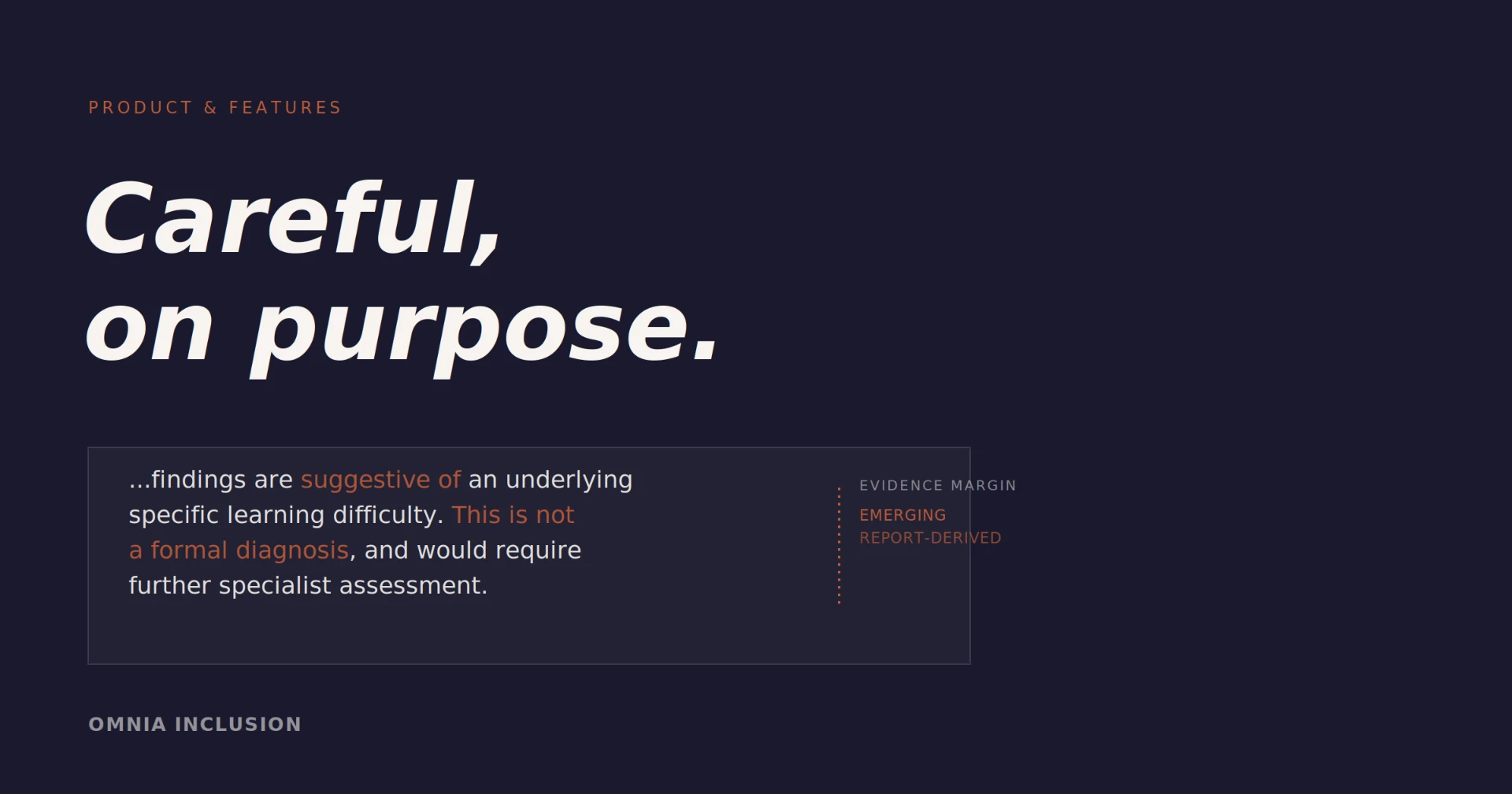
"Suggestive of an underlying specific learning difficulty consistent with dyslexia. However, this is not a formal diagnosis." That sentence, or something close to it, appears in a huge number of the EP reports that land on a SENDCo's desk. The hedging isn't sloppy writing. It's the assessor being precise about what they actually found, and precise about what they didn't.
It's also exactly the kind of sentence a language model can get badly wrong. Ask an AI to summarise that report into a plan and there's a real risk it comes back stating the pupil "has dyslexia," quietly dropping the hedge because a confident sentence reads better than a careful one.
Why this matters more than it sounds
A flattened hedge isn't a minor wording issue. It can shape how a school talks to a family, what gets written into a statutory document, and whether a pupil ends up labelled with something that was only ever a possibility. Once a false certainty is written into a plan, it tends to get repeated, cited, and believed, long after the original report's careful language is forgotten.
The report said 'suggestive of.' If the plan says 'has,' something has gone wrong, quietly, in the middle.
How OMNIA actually handles this
When a diagnostic report is uploaded and indexed, OMNIA doesn't summarise it freely. It retrieves only the specific passages relevant to the target being drafted, and instructs the model, explicitly, to extract from that text rather than infer beyond it. Hedged language has to stay hedged. A tentative finding cannot become a stated fact.
What this looks like in practice
We tested this against a real, deliberately ambiguous report. Findings phrased as "suggestive of... not a formal diagnosis" came through into the generated plan exactly as written, hedge intact, with a citation pointing straight back to the source report and its date. Nothing was invented. Nothing was firmed up.
This is a small thing to get right and an easy thing to get wrong. We'd rather build the version that respects how carefully these reports were actually written.
OMNIA's evidence base and citation approach are described in full on our Evidence base page.