
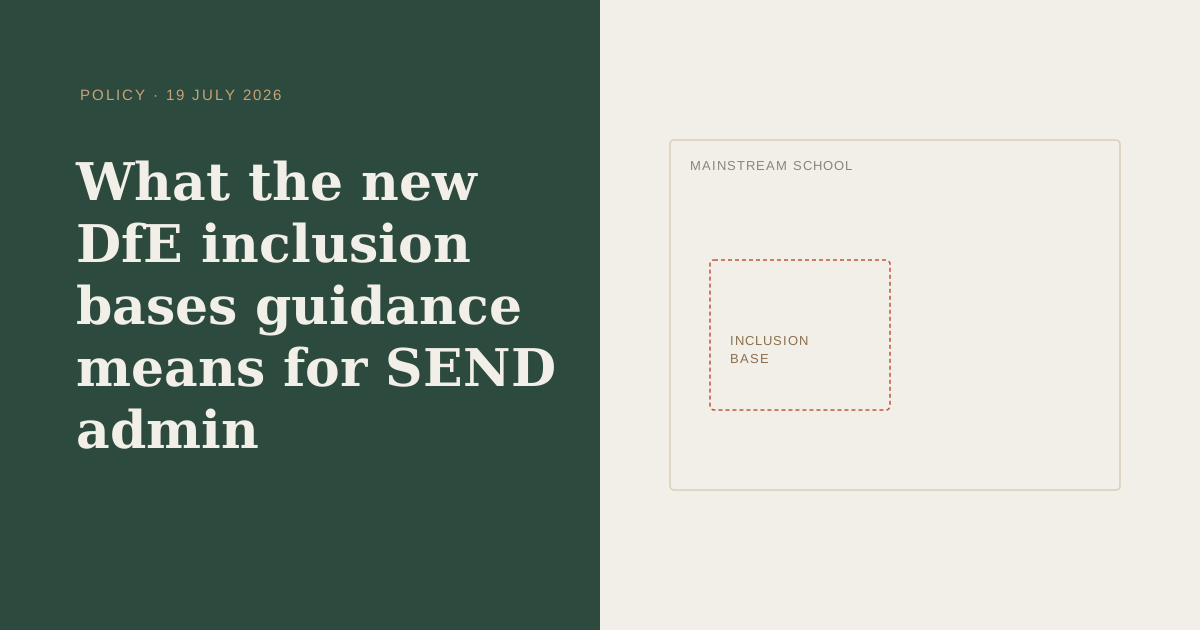
In June 2026, the Department for Education published its first standalone guidance on inclusion bases: the SEN units, resourced provisions, and pupil support units now brought under one term and one set of expectations. It replaces three overlapping labels with a single model, and it sets out six principles of effective practice that schools are expected to demonstrate, not just describe.
The terminology has changed, and so has the expectation
SEN unit, resourced provision, and pupil support unit are now all inclusion bases, split into two commissioning models: support bases, funded by the school or trust, and specialist bases, commissioned and funded by the local authority. The distinction matters less for day-to-day practice than the six principles that now apply regardless of funding route: inclusion, curriculum, data and outcomes, workforce, partnership, and physical environment.
The continuum model is the headline idea
Rather than treating a base as either fully separate or fully integrated, DfE frames it as a continuum: bases and individual children can sit anywhere between a dedicated learning area and a model where the base mainly supports access to mainstream classes. Schools are expected to know where their base sits, review that position regularly, and be able to show movement toward more mainstream time where appropriate.
Schools should reflect on where their base currently sits within this continuum, regularly review their arrangements, and prioritise movement towards models that support children and young people to spend more time in mainstream classes.
What this actually asks schools to record
Underneath the six principles sit some concrete, auditable expectations. Clear entry and exit criteria for the base. Baselining on arrival. At least three different sources of quality assurance each year, drawn from responsible body review, staff self- or peer-evaluation, pupil and parent voice, local authority review, or peer school review. Destinations data tracked after a child leaves the base, not just while they're in it.
Where the admin burden lands
Most schools running a base already do the practice well. What's harder is showing it: pulling together entry criteria, baseline data, QA sources from five different places, and destinations tracking, in a form that stands up to a trust review or an Ofsted conversation. That's an evidencing problem, not a practice problem, and it's exactly the kind of administrative load OMNIA is built to take off SENDCo and base-lead teams.
This post draws on DfE's Inclusion bases in schools guidance, published June 2026, now included in OMNIA's evidence base.